

Everyone Is Investing in AI. But Is Your Organization Ready?
AI continues to dominate conversations across the enterprise. Budgets are increasing, pilot programs are expanding, and boards are asking tougher questions about how AI investments will translate into measurable business outcomes.
Yet one reality remains: adopting AI is not the same as being ready for it.
Many organizations have already introduced AI into at least one business function, but far fewer have turned those early initiatives into scalable, organization-wide value. The reason is rarely the technology itself. More often, success depends on whether employees trust the change enough to use AI effectively, consistently, and at scale.
This is the gap many transformation strategies overlook. While organizations invest heavily in AI platforms and technical capabilities, they often invest less in the leadership, communication, and employee experience that enable lasting adoption. Without those foundations in place, even the strongest AI strategy can struggle to achieve its intended impact.
That is the hidden gap in many transformation strategies. Organizations often invest heavily in the tech stack while underinvesting in the leadership behaviors, communication rhythms, and employee experience required to make adoption stick. The result is predictable:
- licenses are purchased, but usage remains shallow
- tools are launched, but workflows do not change
- leaders promote innovation, but employees hesitate in silence
In large companies, AI failure is rarely a systems problem first. It is a trust problem first.
The Real Risk: High Tech Readiness, Low Human Readiness
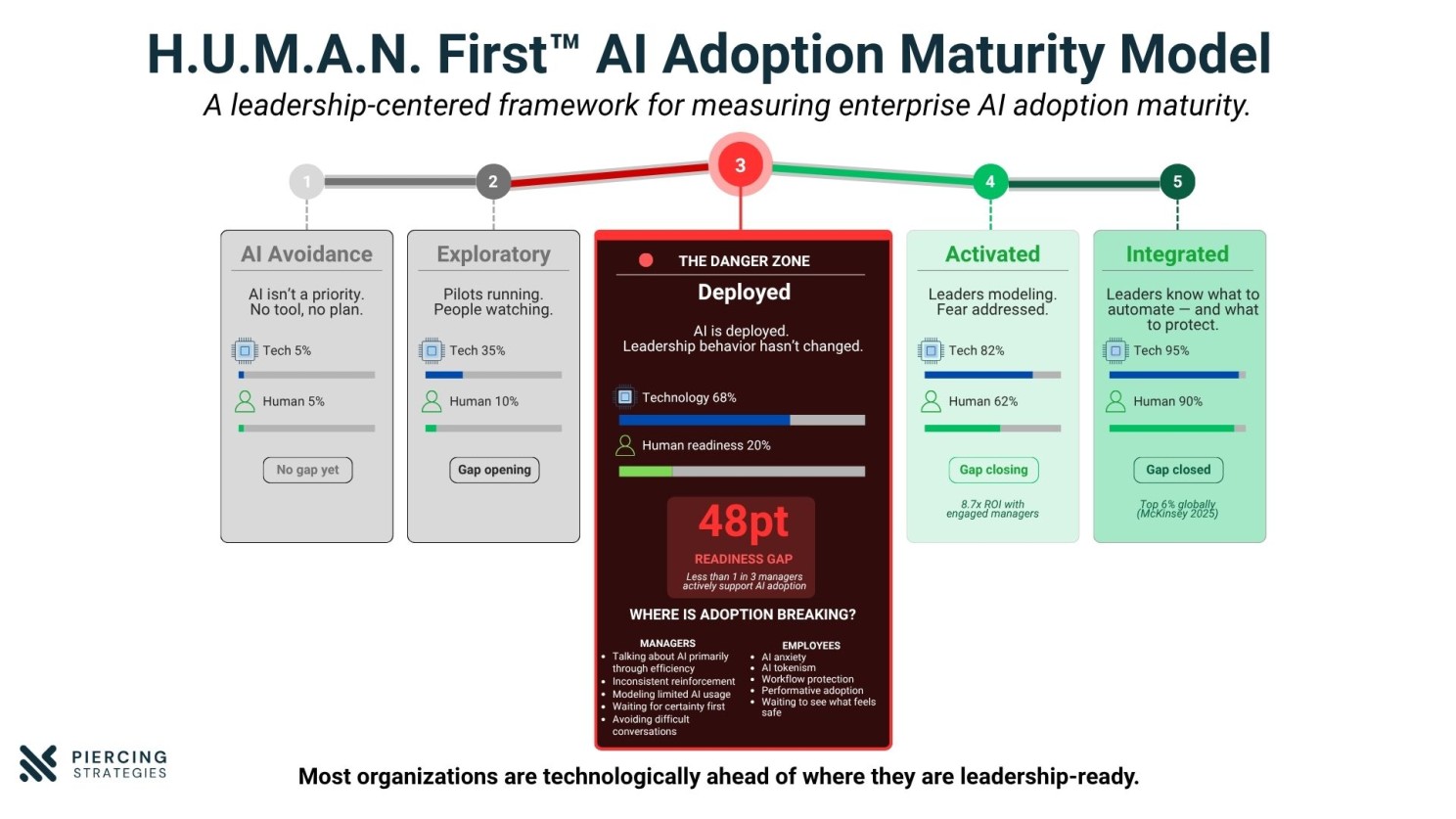
This is where many enterprises enter what Piercing Strategies calls the Danger Zone: high technology readiness paired with low human readiness.
It looks polished on the surface. The infrastructure is in place. Governance committees have been formed. New tools are introduced with urgency. But underneath that progress, employees are still asking critical questions:
- What does this mean for my role?
- Is this tool helping me, or monitoring me?
- Can I safely experiment and learn?
- Do leaders actually understand how this change affects my team?
When those questions go unanswered, trust erodes. And once trust erodes, adoption slows down—even when the technology is objectively sound.
That is why trust should be treated as a business metric, not a soft concept. Trust accelerates adoption, strengthens collaboration, improves feedback quality, and reduces resistance across the organization. In practical terms, trust is what turns AI from an announcement into an operating capability.
The H.U.M.A.N. First™ Framework: The Right Model for AI Adoption
At Piercing Strategies, AI adoption is approached as a leadership and organizational sustainability challenge—not merely a technical deployment. That is exactly why the H.U.M.A.N. First™ framework matters.
The correct framework is:
- Hearing: Leaders must actively hear employee concerns, signals of resistance, and frontline realities before rolling out change at scale. AI adoption strategies fail when organizations communicate to employees without first listening to them.
- Understanding: Once concerns are surfaced, leaders must build shared understanding around why AI is being introduced, what business problem it is solving, and how success will be measured. Ambiguity creates fear; clarity builds trust.
- Motivating: Employees need a compelling reason to engage. That means connecting AI adoption to meaningful outcomes such as reduced administrative burden, faster decision-making, stronger customer experience, and improved team performance.
- Amplifying: Early wins, trusted champions, and credible manager voices must be amplified across the organization. Adoption scales faster when people see peers using AI responsibly and successfully in real business contexts.
- Navigating change: Sustainable adoption requires structured support through uncertainty. Leaders must help teams navigate new workflows, evolving expectations, skill development, and the emotional realities of change over time.
This is the difference between rolling out a tool and leading a transformation.
Why Trust Delivers the Strongest Return
If leaders want to improve AI ROI, they should start by asking a different question. Not “How fast can we deploy?” but “How much trust do we have to support adoption at scale?”
That question matters because trust produces measurable organizational advantages. When trust is high:
- employees are more willing to test new tools and share honest feedback
- managers address resistance earlier instead of masking it
- cross-functional teams collaborate with less friction
- learning curves shorten because people are less afraid to get it wrong
- change fatigue decreases because communication feels credible and consistent
In other words, trust reduces the behavioral drag that slows transformation.
For enterprise leaders, that is the real return. Not just faster implementation, but stronger utilization. Not just initial excitement, but sustained behavior change. Not just innovation theater, but measurable business value.
What Executives Should Do Next
For organizations leading AI adoption in complex environments, several priorities stand out:
- Start with a trust audit. Assess psychological safety, leadership credibility, and employee sentiment before expanding AI initiatives.
- Equip managers first. Mid-level leaders are the translation layer between strategy and employee experience. If they are unclear, the organization will be unclear.
- Communicate the “why” repeatedly. One announcement is never enough. Trust grows through repetition, transparency, and consistency.
- Create visible feedback loops. Employees are more likely to support adoption when they can see their concerns being heard and addressed.
- Celebrate practical wins. Highlight where AI improves work quality, collaboration, speed, or decision support—not just where it sounds innovative.
Organizations that lead this way are not simply implementing AI. They are building the internal conditions required for AI to deliver lasting value.
Final Thought: If Trust Is Low, ROI Will Be Too
The enterprise conversation around AI often focuses on capability, speed, and competitive advantage. Those factors matter. But in practice, the organizations that realize meaningful returns are usually the ones that solve for trust first.
That is the real ROI story.
When people trust leadership, trust the process, and trust that change is being managed with intention, AI adoption becomes more than a technology initiative. It becomes a catalyst for stronger alignment, healthier leadership pipelines, and more sustainable transformation.
If your organization is preparing for large-scale AI adoption, Piercing Strategies can help. Through our award-winning H.U.M.A.N. First™ approach, we partner with enterprise leaders to build trust, strengthen readiness, and guide change in ways that produce measurable business value.
Ready to lead AI adoption with trust at the center?
See More Posts

Your Organization Has an AI Strategy. It Doesn’t Have an AI Manifesto. Here’s the Difference and Why It’s Costing You.
Most organizations navigating AI transformation have produced some version of the same document. It lives in a SharePoint folder nobody bookmarks. It outlines acceptable use policies, data privacy guardrails, and compliance requirements. It was written by legal,...

Cisco Just Gave 90,000 Employees an AI Agent. Here’s What That Announcement Reveals About What’s Coming for Your Organization.
Last week, Cisco announced that, beginning in its new fiscal year, each of its 90,000 employees will have a personalized AI agent—an assistant capable of answering questions, carrying out tasks, and working across functions ranging from finance and investor relations...

5 Ways Managers Can Connect AI to Career Growth
The data is clear: organizations where leaders explicitly connect AI to career growth are more than twice as likely to see higher adoption. Not twice as likely to see better outputs. Twice as likely to see people actually use it. And yet most organizations are leaving...