

Nearly every organization today has an AI strategy. Far fewer have a clear understanding of the factor that ultimately determines whether that strategy succeeds.
The most important question isn’t which AI tools are being deployed or what adoption targets have been set for the next quarter. It’s a more fundamental one: Where does your organization stand today—not in terms of technology implementation, but in terms of human readiness?
When organizations take an honest look at that question, many discover they’re at a different stage of AI maturity than they initially believed. While technical capabilities may be advancing quickly, organizational readiness often tells a different story.
Understanding that distinction requires looking beyond traditional technology maturity models. It calls for a framework that measures the human side of AI adoption—because that’s where lasting transformation begins.
The model most organizations are missing.
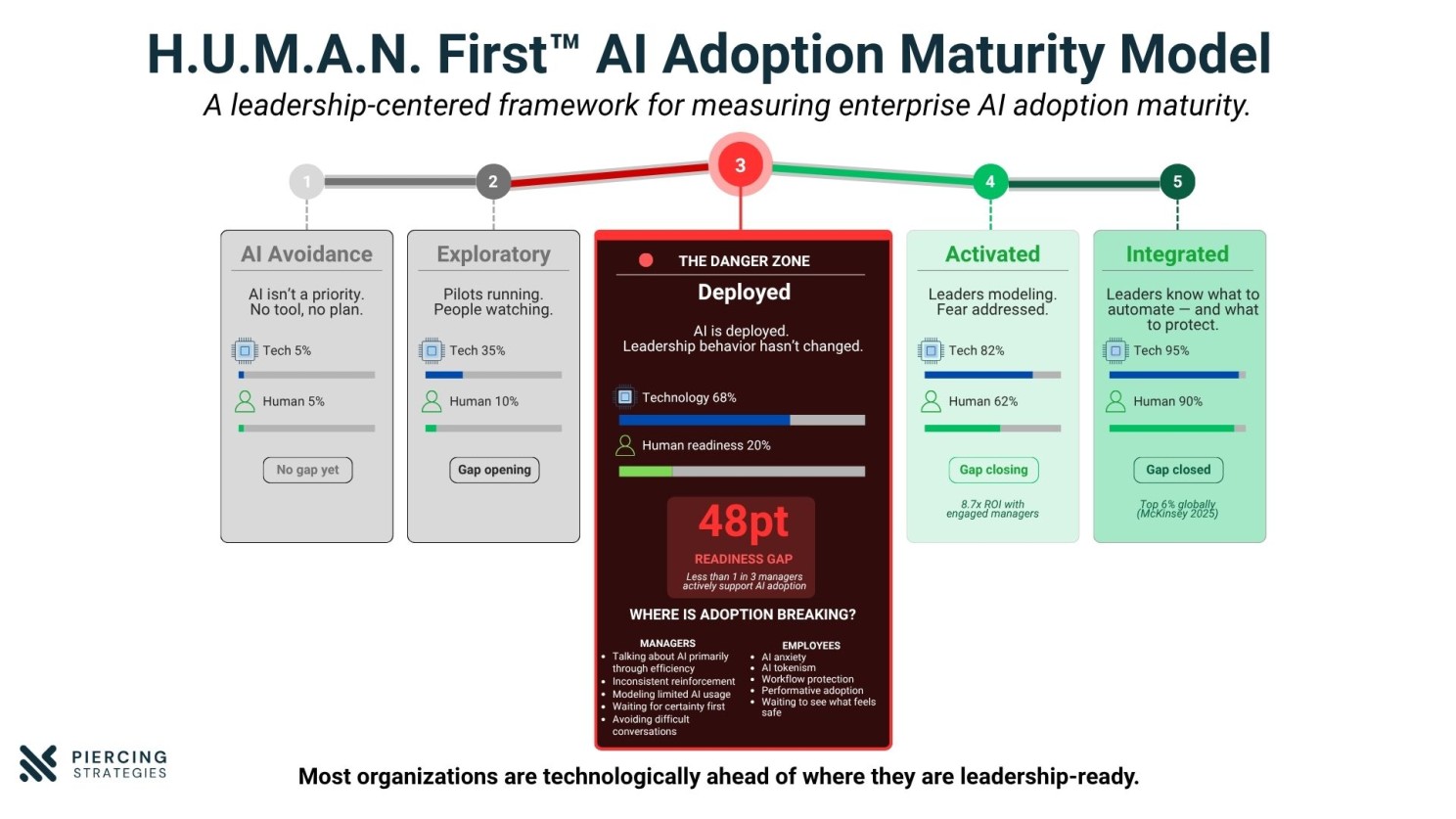
There are five stages of AI adoption maturity. Most conversations about AI focus exclusively on the technology axis — how deployed, how integrated, how optimized. What that conversation consistently misses is the human readiness axis sitting right next to it.
Because those two numbers are not moving together. And the gap between them is where AI investments go to underperform.
Here’s what the maturity model actually looks like:
Stage 1 — AI Avoidance. AI isn’t a priority. No tool, no plan. Technology readiness at 5%. Human readiness at 5%. No gap yet — but also no movement.
Stage 2 — Exploratory. Pilots running. People watching. Technology at 35%. Human readiness at 10%. The gap is opening, but it’s still early enough to close without major damage.
Stage 3 — Deployed. The Danger Zone. AI is deployed. Leadership behavior hasn’t changed. Technology at 68%. Human readiness at 20%. A 48-point readiness gap. Less than 1 in 3 managers actively supporting AI adoption.
Stage 4 — Activated. Leaders modeling. Fear addressed. Technology at 82%. Human readiness at 62%. Gap closing. Organizations at this stage see 8.7x ROI with engaged managers.
Stage 5 — Integrated. Leaders know what to automate — and what to protect. Technology at 95%. Human readiness at 90%. Gap closed. According to Gartner, only 6% of organizations globally have reached this stage.
In my conversations with leaders, most organizations reading this are sitting in Stage 3.
What Stage 3 actually looks like from the inside
Stage 3 is the most dangerous stage on the model — not because the technology isn’t working, but because it creates the illusion that the work is done. The tools are deployed. The training happened. The dashboard shows utilization. From the outside, and in most board presentations, this looks like progress.
From the inside it looks like this:
- On the manager side — AI is being discussed primarily through the lens of efficiency. Reinforcement is inconsistent. Managers are modeling limited AI usage, waiting for certainty before leading with confidence, and avoiding the difficult conversations their teams are actively waiting for them to have.
- On the employee side — AI anxiety is present and unaddressed. Tokenism is creeping in (check out last week’s newsletter if you haven’t heard of this new AI term). Workflows are being quietly protected. Adoption is being performed rather than practiced. People are waiting to see what actually feels safe before they commit.
This is not a technology problem. The technology is doing exactly what it was designed to do.
This is a leadership readiness problem. And the 48-point gap between where organizations are technologically and where they are on human readiness is not a rounding error. It is the difference between a transformation and an expensive experiment.
The diagnostic questions that tell you where you actually are
If you want an honest read on your organization’s stage, skip the utilization dashboard. Ask these four questions instead:
- Are your managers talking about AI as a tool for efficiency — or as a development opportunity for their teams? If the answer is efficiency only, you are in Stage 3.
- When an employee comes to their manager and says “I’m not sure where I fit in this new model” — does the manager have a real answer, or a deflection? If it’s a deflection, you are in Stage 3.
- Are your highest performers visibly, genuinely using AI in ways that are changing their output — or are they compliant and quiet? Quiet high performers in an AI rollout are a Stage 3 signal.
- Has your leadership team had an explicit conversation about the difference between performative adoption and real adoption — and what each one looks like? If that conversation hasn’t happened, you are in Stage 3.
The organizations that move from Stage 3 to Stage 4 don’t do it by deploying more technology. They do it by closing the readiness gap — equipping managers to lead through the change rather than around it, creating the psychological safety that turns compliance into commitment, and building the human infrastructure that makes the technology investment perform.
The number worth remembering
8.7x.
That is the ROI multiplier for organizations with engaged managers at Stage 4. Not a small increment. Not a marginal improvement. 8.7 times the return — driven not by a better tool, but by a better-prepared leadership layer.
The organizations sitting in Stage 3 right now are one decision away from that number. The decision is not a technology decision.
The question for your leadership team this week
If you mapped your organization on this model today — honestly, not aspirationally — where would you land?
And if the answer is Stage 3, the more important question is: what is the cost of staying there through the next quarter?
Because the gap doesn’t close on its own. It compounds.
See More Posts

Your Organization Has an AI Strategy. It Doesn’t Have an AI Manifesto. Here’s the Difference and Why It’s Costing You.
Most organizations navigating AI transformation have produced some version of the same document. It lives in a SharePoint folder nobody bookmarks. It outlines acceptable use policies, data privacy guardrails, and compliance requirements. It was written by legal,...

Cisco Just Gave 90,000 Employees an AI Agent. Here’s What That Announcement Reveals About What’s Coming for Your Organization.
Last week, Cisco announced that, beginning in its new fiscal year, each of its 90,000 employees will have a personalized AI agent—an assistant capable of answering questions, carrying out tasks, and working across functions ranging from finance and investor relations...

5 Ways Managers Can Connect AI to Career Growth
The data is clear: organizations where leaders explicitly connect AI to career growth are more than twice as likely to see higher adoption. Not twice as likely to see better outputs. Twice as likely to see people actually use it. And yet most organizations are leaving...